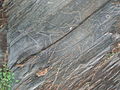
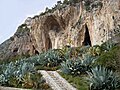
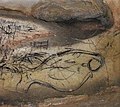
Every site in the atlas, laid down like strata — the newest art near the surface, the oldest in the deepest layer. Descend through sixty millennia of image-making, era by era.
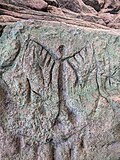
Rock art never ended. Some traditions carried on into recorded history, and for many Indigenous communities the painted country is still alive, storied and sacred today.
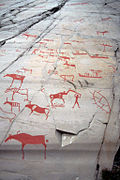
Metal, ships and warriors enter the picture. Scandinavian coastal rocks fill with fleets and axe-bearers, while in southern China whole cliff faces above the river become murals of drummers and dancers.
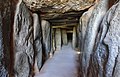
Farmers became the new artists. Art moved into the open and onto monuments — engraved on Scandinavian shores, painted across African shelters, and carved into great tombs like Newgrange, where spirals turn with the winter sun.
A warmer, greener world. The Sahara was a savanna whose people painted cattle, dancers and swimmers; from Arabia to the Horn of Africa, rock art turned from the beasts of the hunt to the herds people lived by.
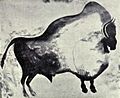
As the ice retreated, the painted world spread and changed. Niaux's black bison close the Magdalenian in Europe, while across the ocean the first South Americans blew ochre over their hands at Cueva de las Manos.
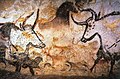
The golden age of the painted cave. Lascaux's great bulls, Font-de-Gaume's bison and the haunting sorcerer of Les Trois-Frères belong to this flowering of Ice Age culture at its most elaborate and profound.
Art at the coldest depth of the Ice Age. As glaciers pushed people into southern refuges, engravers worked the open-air valley of the Côa, painters spotted the horses of Pech Merle, and hunters filled the shelters of Serra da Capivara.
The age of the hand stencil. Across Europe people pressed hands to the rock and blew ochre around them — at Gargas, at Cosquer whose entrance now lies beneath the sea — while mammoths and ibex filled the walls.
The first modern humans in Europe arrived with a fully formed artistic vision. In Chauvet's darkness they drew lions, rhinoceroses and horses with a confidence that still stuns — art's opening act was already a masterpiece.
Image-making is older than Europe's first modern humans. Painted signs in Iberian caves may be the work of Neanderthals, and in Sulawesi people were painting wild pigs and hunting scenes more than 45,000 years ago — the oldest narrative art known.