
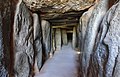
In 1699, labourers hauling stone for landowner Charles Campbell dug into what looked like a cairn — and struck the carved entrance of a passage tomb. The antiquarian Edward Lhwyd happened to be touring Ireland and wrote the first account; it took nearly three more centuries to understand what the spirals meant, and that the chamber caught the midwinter sun.
A timeline of discovery
The same sites, the other story: not when the art was made, but when the modern world found it again — and who opened each door. Children and dogs, farmers and abbés, skeptics, spelunkers and one very determined diver.
Antiquarians & Accidents
Before anyone knew what they were looking at: labourers quarrying into a painted tomb, landowners poking around "bear caves", travellers scratching their names over Ice Age walls. The finds pile up; the understanding has not arrived.
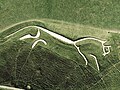
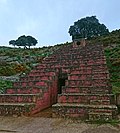
The cave had been sealed for millennia when, in 1821, a great earthquake centred on Alhama de Granada shook southern Spain — and cracked open an entrance in the hillside. Locals walked in through a door the earth itself had made; the red marks on the stalagmites turned out, two centuries later, to be among the oldest painted surfaces known.


The Age of Disbelief
A little girl looks up at a ceiling of bison — and the learned world laughs her father out of the room. It takes cave after cave, and a quarter of a century, before prehistory’s greatest apology gets written.

A hunter’s dog squeezed after a fox in 1868 and led Modesto Cubillas to a hidden mouth in the hillside. Eleven years later the landowner Marcelino Sanz de Sautuola dug the floor while his eight-year-old daughter María wandered deeper — and looked up. “Look, Papá — oxen!” The learned world called her father a fraud; he died before the 1902 apology proved the child right.


François Daleau, a Bordeaux wine merchant with a scientist’s patience, found the choked cave in March 1881 and dug it for years, noting “interlocking lines” he couldn’t read in the lamplight. On 31 August 1896, with more fill cleared, the lines resolved into animals — some of the first cave engravings ever recognized, five years before the discipline believed such things.

Édouard Piette began digging the riverbank deposits of the great tunnel in 1887 and pulled out pebbles painted with dots and bars — so strange he named a whole culture, the Azilian, after the cave. The painted and engraved walls deeper in were only recognized in the new century, once the world had learned to believe in cave art.

The Reverend James Harvey uncovered the great carved slab above the Clyde in 1887, its hundred spirals and cups already ancient beyond guessing. By 1965 picnickers and vandals had scratched it so badly that archaeologists made a heartbreaking choice: they buried the whole stone under earth to save it. It has surfaced only once since, briefly, for laser scanning in 2016.

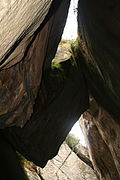

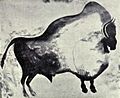
On 12 September 1901, the village schoolmaster Denis Peyrony walked into a gallery of painted bison a few minutes from Les Eyzies — four days after he, Louis Capitan and Henri Breuil had authenticated the engravings of Les Combarelles next door. Two caves in one week, in one valley: the case for Ice Age art was suddenly unanswerable.

On 8 September 1901, Denis Peyrony, Louis Capitan and a young Henri Breuil crawled down a winding corridor near Les Eyzies and recognized, by candlelight, hundreds of engraved horses and reindeer. It was the first blow of an extraordinary week — Font-de-Gaume followed four days later — that ended the age of disbelief for good.
The Golden Age
After the mea culpa of 1902, the floodgates open. Abbés and schoolmasters, brothers in a homemade boat, quarry blasts and curious farmers — in under four decades the map of ancient art fills in faster than it ever will again.


In 1903 Hermilio Alcalde del Río, a restless engineer-turned-prehistorian surveying the Cantabrian hills, squeezed into a cave on the conical Monte Castillo — and found walls layered with hands, discs and beasts. A century later, one of those red discs would be dated past 40,000 years, the threshold of the deepest art known in Europe.
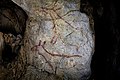

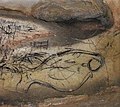

Commandant Molard, a military engineer, was mapping the vast Pyrenean cave with his two sons in 1906 when their survey reached a black-walled rotunda deep inside — the Salon Noir, its bison drawn with a draughtsman’s economy. Visitors had been scrawling their names beside the animals for two centuries without ever asking who painted them.

The cave had a dark reputation — an 18th-century murderer was said to have laired there — and tourists had wandered it for decades. Then, in 1906, the naturalist Félix Regnault looked properly at the walls and saw what everyone had walked past: hundreds of stencilled hands, many with shortened fingers, pressed onto the rock across 27,000 years.

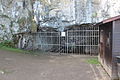


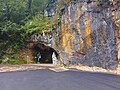

On 21 July 1914, weeks before the war, the three sons of Count Henri Bégouën — Max, Jacques and Louis, who had already rafted the underground Volp into Tuc d’Audoubert — wriggled through a crevice into a new cavern. The cave was named for them, the Three Brothers; its horned, staring “Sorcerer” has unsettled every visitor since.


In 1922, the teenagers André David and Henri Dutertre followed a draught through a narrow slip of the Lot plateau and came out beneath the spotted horses. The local priest, Amédée Lemozi, authenticated the find and became its scholar; the boys spent the rest of their lives guiding visitors through their cave.


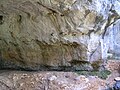


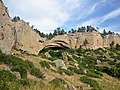
Around 1930, quarrymen cutting stone in the scorched hills above the Caspian began noticing figures under their chisels — boats, dancers, long-horned bulls. Work stopped; the archaeologist Isak Jafarzadeh arrived at the decade’s end and began cataloguing what became thousands of carvings spanning perhaps forty millennia.


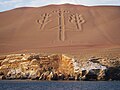
In October 1933, deep in the hyperarid Gilf Kebir, the Hungarian desert explorer László Almásy found a shelter whose small red figures seemed, impossibly, to be swimming. He argued the Sahara had once held water — a heresy then, a certainty now. The site later drifted into fiction as a setting of “The English Patient.”


Teenagers, Farmers & Chance
A dog down a foxhole, boys chasing bats, a zoologist who came for hibernating bats and left with horses: the mid-century boom belongs to amateurs who were not looking for art at all.
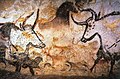
On 8 September 1940, a dog named Robot went down a hole left by a fallen pine. Four days later, eighteen-year-old Marcel Ravidat came back with three friends, a knife-widened opening and an oil lamp — and dropped into a hall of bulls the size of buses. The teenagers guarded their cave for days before telling their schoolmaster.


The Allies stored munitions in the caves of Monte Pellegrino after taking Palermo in 1943 — until the depot went up. The blast sheared away the weathered wall faces, and out of the scar emerged an engraved ring of dancing figures. Formal study had to wait for the archaeologist Jole Bovio Marconi in the early 1950s.


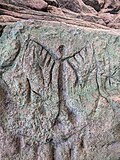
In the summer of 1950, a fifteen-year-old on a seaside swimming trip from Sapporo poked into a sandy hollow near Yoichi. His older brother’s high-school history club came back with their teacher, and the sand gave up pottery — then walls covered with horned and winged figures, one of only two engraved caves in all Japan.


The vast cave had been visited — and scribbled in — since the sixteenth century. Yet when Louis-René Nougier and Romain Robert announced in 1956 that its ceilings carried a hundred mammoths, half the discipline cried forgery: how could centuries of visitors have missed them? The frieze won; the doubters, once again, lost.


In 1957, the archaeologist Vishnu Shridhar Wakankar was riding a train south from Bhopal when he saw, through the window, rock formations that reminded him of painted shelters he had studied abroad. He got off, walked into the hills — and found one of the greatest painted shelter complexes on Earth, its images spanning ten thousand years.


In January 1959, Alexander Ryumin, a zoologist at the Bashkir nature reserve, went underground looking for hibernating bats. His torch found horses and mammoths in red ochre instead — the first Ice Age paintings ever discovered in Russia, two thousand kilometres east of where science said such art could exist.

On 12 January 1959, five boys from Maro — José Luis Barbero, brothers Manuel and Miguel Muñoz, Francisco Navas and José Torres — slipped through a bat hole in a hollow they called “the cemetery mines.” Beyond it opened one of Spain’s great caverns; skeletal remains watched them from the floor. The town has lived off their curiosity ever since.

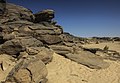




In March 1965, the painter Carlos “Botong” Francisco — later a National Artist of the Philippines — was camping with his boy-scout troop in the hills above Angono when he noticed carvings in the shallow shelter wall: 127 dancing, froglike figures. The country’s oldest known artwork was found on a scout trip.

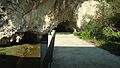
In April 1968, a young mountaineering club dropped into an unexplored cave system by the Sella river and walked out beneath a painted ceiling of horses and reindeer. Days later, one of them — Celestino “Tito” Fernández Bustillo — was killed in a mountain accident. His friends gave the cave his name.

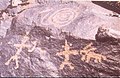

Cavers & Divers
The easy doors are all open; what remains demands ropes, wetsuits and nerve. Climbing clubs squeeze through sumps, and a commercial diver follows a drowned tunnel into a chamber the sea had sealed since the Ice Age.

On 8 September 1969, Rafael Rezabal and Andoni Albizuri of the Antxieta society in Azpeitia felt cold air seeping from a small stone-plugged hole on Ekain hill. They pulled the stones away, crawled in — and found a gallery of horses so perfect it has been called the finest panel of Ice Age painting anywhere.
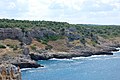
On 1 February 1970, cavers of the Salento speleological group from Maglie pushed into a fissure by the little cove of Porto Badisco. Corridor after corridor ran with brown guano-paint: hunters, deer, spirals, shamans — the richest Neolithic painted cave in Europe, hidden a few steps from the beach.


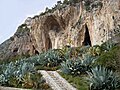
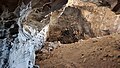


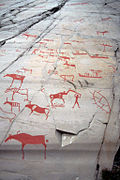
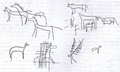


In 1985, the professional diver Henri Cosquer found a dark tunnel 37 metres down off Marseille and followed it, dive after dive, until it surfaced in a dry chamber. In July 1991 his companions spotted a stencilled hand; that September, three divers from another group lost their way in the tunnel and drowned. Only then was the drowned Ice Age sanctuary revealed to the world.



The Ongoing Hunt
Chauvet resets everything in 1994 — and the hunt only accelerates: dating revolutions in Sulawesi, drones over desert gorges, a five-character signature waiting a millennium to be read. The map is still being drawn.

On 18 December 1994, three cavers — Jean-Marie Chauvet, Éliette Brunel and Christian Hillaire — felt a draught breathing from a rubble-choked hollow above the Ardèche gorge. They cleared the stones, dropped a ladder into the dark, and stood before lions and rhinoceroses twice as old as Lascaux, in a cave sealed since the Ice Age.

From 1994, the French caver Luc-Henri Fage and archaeologist Jean-Michel Chazine, with Indonesian colleagues, pushed expedition after expedition into Borneo’s remote Sangkulirang karst. A Dayak birds’-nest hunter named Saleh guided them to the painted chambers that now bear his name — where an ochre bovid later proved at least 40,000 years old.

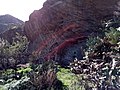


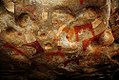
Herders had sheltered their goats under the painted overhangs for generations and told no outsiders. In November 2002, a French team led by Xavier Gutherz, surveying for early pastoral sites, was shown the granite hill — and found ceiling after ceiling of ceremonial cattle in colours so fresh they seemed decades, not millennia, old.


On 20 September 2009, five Romanian cavers — Tudor Rus, Mihai Besesek, Valentin Radu, Roxana Tociu and Marius Kenesz — traversed the flooded galleries of a long-known Apuseni cave, wading and swimming where few had bothered. Past the sumps, charcoal animals waited on the walls: at over 30,000 years, the oldest dated cave art in Central Europe.


In December 2017, an archaeological survey led by Basran Burhan reached a valley in the Sulawesi karst so enclosed that its Bugis farmers said no Westerner had ever entered; floods seal the only way in for most of the year. On a shelter wall hung a warty pig in red ochre — dated in 2021 to at least 45,500 years, then the oldest known figurative painting on Earth.

Archaeologists from the Margulan Institute began systematically walking the gorge in 2024, cluster by cluster, counting past twelve hundred carvings. Among the goats and camels, five faint runic characters resolved into a sentence that had waited a thousand years for a reader: “My name is Aba.”
The newest find in this atlas dates from 2024 — and the hunt has not stopped. Gorges go unwalked, karst goes unmapped, and datings keep pushing the oldest art further back. The map is still being drawn.
Go find some caves yourself →